Poster zum Fallbericht Achalasie
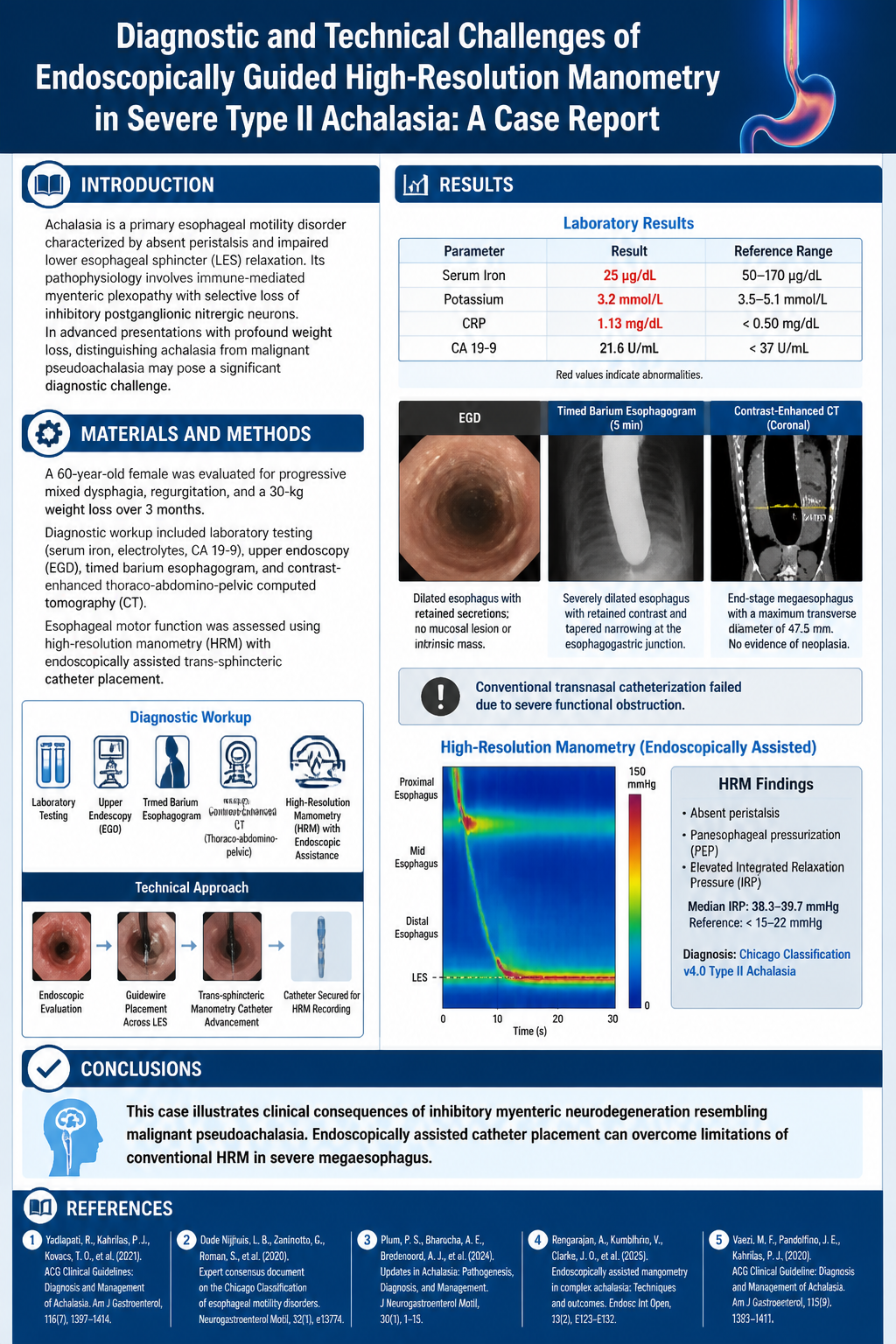
Academic medical poster in portrait 9:16 format. Professional blue and white color theme. Structured layout with clear sections. TITLE: Diagnostic and Technical Challenges of Endoscopically Guided High-Resolution Manometry in Severe Type II Achalasia: A Case Report INTRODUCTION: Achalasia is a primary esophageal motility disorder characterized by absent peristalsis and impaired lower esophageal sphincter (LES) relaxation. Its pathophysiology involves immune-mediated myenteric plexopathy with selective loss of inhibitory postganglionic nitrergic neurons. In advanced presentations with profound weight loss, distinguishing achalasia from malignant pseudoachalasia may pose a significant diagnostic challenge. MATERIALS AND METHODS: A 60-year-old female was evaluated for progressive mixed dysphagia, regurgitation, and a 30-kg weight loss over 3 months. Diagnostic workup included laboratory testing (serum iron, electrolytes, CA 19-9), upper endoscopy (EGD), timed barium esophagogram, and contrast-enhanced thoraco-abdomino-pelvic computed tomography (CT). Esophageal motor function was assessed using high-resolution manometry (HRM) with endoscopically assisted trans-sphincteric catheter placement. RESULTS: Laboratory testing demonstrated iron deficiency (25 µg/dL), mild hypokalemia (3.2 mmol/L), mildly elevated CRP (1.13 mg/dL), and CA19-9 within reference range (21.6 U/mL). EGD and CT excluded neoplasia, demonstrating end-stage megaesophagus (transverse diameter 47.5 mm). Conventional transnasal catheterization failed due to severe functional obstruction. Endoscopically assisted placement enabled HRM, revealing absent peristalsis, panesophageal pressurization (PEP), and elevated integrated relaxation pressure (median IRP = 38.3-39.7 mmHg; reference <15-22 mmHg). Diagnosis: Chicago Classification v4.0 type II achalasia. CONCLUSIONS: This case illustrates clinical consequences of inhibitory myenteric neurodegeneration resembling malignant pseudoachalasia. Endoscopically assisted catheter placement can overcome limitations of conventional HRM in severe megaesophagus. REFERENCES: Yadlapati et al. (2021) | Oude Nijhuis et al. (2020) | Plum et al. (2024) | Rengarajan et al. (2025) | Vaezi et al. (2020)
Mehr davon